Quick answer
A garden hose may be recyclable through a program that specifically accepts it, but do not assume it belongs in your curbside recycling cart. Rules are set locally, so the practical answer is to check with the company or public agency that handles your waste before putting the hose in any bin. If it is still useful, repairing or reusing it can be a better first option; if no accepted recycling route exists, follow your local disposal directions.
The U.S. Environmental Protection Agency (EPA) advises people to check what their local program accepts because recycling rules differ by community. It also notes that a recycling-style resin code on a plastic item does not necessarily mean the item is collected where you live. EPA: How Do I Recycle Common Recyclables?
Featured image: Water spraying from a garden hose.
Photo: Garden Hose by Skakerman (Archive), https://www.flickr.com/photos/27482959@N08/3555980548; https://creativecommons.org/licenses/by/2.0/. Resized and padded. Illustrative stock photo; no product testing is implied.
Start with the option that fits the hose’s condition
An old hose does not belong in curbside recycling just because it looks like plastic or rubber. Programs decide which items they accept, and fittings or construction can matter. Ask about the whole hose, not just what it seems to be made of.
Before deciding that disposal is necessary, take a quick look at the hose:
- Is the problem limited to a small puncture, a leaking connection, or a damaged end?
- Does the hose still flex normally, without widespread splitting or brittle sections?
- Would a repair leave you with a hose that you can use reliably for an appropriate, noncritical task?
- If it still works, do you have a real second use or someone who can use it now?
A single leak or worn connector can be different from a hose that is deteriorating along its length. For help distinguishing common repairable problems from damage that calls for replacement, see How to Fix a Garden Hose: Patching Holes, Stopping Leaks, and Replacing Damaged Ends.
EPA puts source reduction and reuse ahead of recycling, while recognizing that one approach does not fit every material or situation. In practical terms, consider a repair or useful handoff first—but do not keep an unsafe or unusable hose indefinitely. EPA: Sustainable Materials Management: Non-Hazardous Materials and Waste Management Hierarchy
For example, a hose with one worn connector may still be worth repairing if it would water a garden bed reliably. A hose cracked in several places with no real next use is a better candidate for a confirmed recycling or disposal route.
How to find out whether your hose is accepted
Call or search the website for your local solid-waste agency, curbside hauler, recycling drop-off site, or transfer station. Use the specific terms garden hose, water hose, and, if you know it, the material named on the packaging or hose. A generic search for “plastic recycling” may not answer the question.
Have these details ready:
| Ask the program | Why it matters |
|---|---|
| “Do you accept a complete garden hose?” | It avoids assuming that a general plastics category covers the item. |
| “Can it go in my curbside cart, or only at a drop-off location?” | A material can have a different route from curbside collection. |
| “Should the fittings stay on?” | Do not remove parts unless the program tells you to. |
| “Do you want the hose clean, dry, or prepared in a particular way?” | Follow the facility’s handling instructions instead of guessing. |
| “If you do not accept it, what disposal route do you recommend?” | This gives you a local fallback rather than wish-cycling it. |
Save the answer or program page, especially if rules change by season, service level, or municipality. If you rent, ask the property’s waste provider rather than relying on the city listed on your utility bill.
Do not cut up the hose, remove fittings, or put it in the recycling cart hoping it will be sorted out unless the receiving program tells you to. Instructions from one facility may not apply to another.
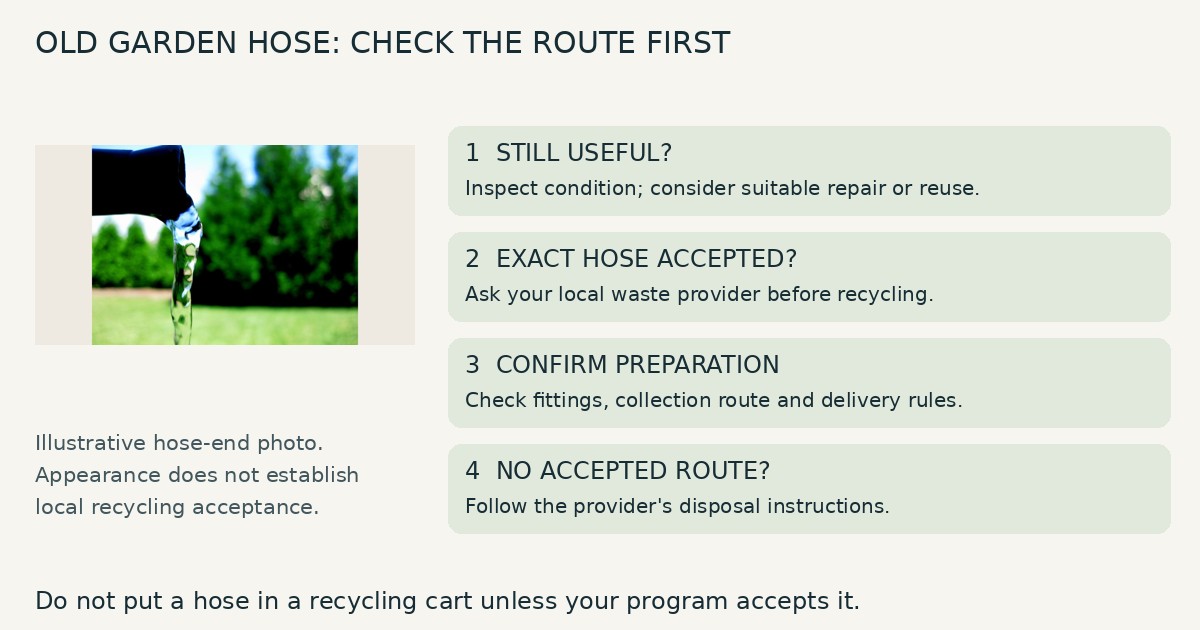
Use this decision path before choosing a bin or drop-off route. Local instructions control acceptance and preparation.
Decision guide: Sprout and Spool, following the article’s EPA-backed local-program and reuse guidance. Photo: Garden Hose by Skakerman (Archive), https://www.flickr.com/photos/27482959@N08/3555169185; https://creativecommons.org/licenses/by/2.0/. Photograph resized and combined with original annotations. Illustrative photo; local acceptance must be verified.
Recycling, repair, reuse, and disposal are different choices
It helps to separate these options rather than treating “recycling” as the only responsible result.
| Option | Best fit | Important limit |
|---|---|---|
| Repair | A localized leak or worn end, where a suitable repair restores useful service | Do not keep repairing a hose that is broadly cracked, brittle, or unreliable for the job. |
| Keep using | The hose remains functional and you have an appropriate use for it | Inspect it periodically and replace it when its condition no longer suits that use. |
| Pass along | A usable hose that another person can inspect and use | Be candid about its condition; do not give away a hose you would not reasonably use yourself. |
| Repurpose | You have a specific, noncritical project for a short length or the whole hose | A vague future project is not a reason to accumulate unusable material. |
| Recycle | A local provider or drop-off site confirms acceptance of the exact item | Use that program’s preparation and delivery instructions. |
| Dispose | The hose is not usable and no verified recovery option accepts it | Use the local waste provider’s stated route rather than putting it in an unapproved bin. |
A repairable hose may serve as a dedicated outdoor wash-down or garden hose even if you no longer want it as your primary hose. If you pass it to a neighbor, disclose leaks, repaired spots, and damaged fittings so they can make an informed choice.
For material repurposing, simple projects are generally easiest to manage when they solve a current problem. For example, a short section can sometimes serve as a protective sleeve where a non-electrical outdoor item might otherwise rub against an edge. Cut or alter a hose only if you can do so safely and the new use will not create a snag, trip, drainage, or water-control problem. Do not represent a repurposed hose as equipment for drinking water or another purpose it was not intended to serve.
If you do not have a present use, do not force one. Storing an unwanted hose for years in the name of reuse can make a later cleanup harder. Properly coil and protect a hose you plan to keep; this guide to storing a garden hose can help reduce kinks and prevent avoidable wear.
What to do when curbside recycling says no
A “no” for the curbside cart is not the same thing as a universal “no” to every recovery option. Ask the provider whether it knows of a separate drop-off, special collection, take-back, scrap-recovery, or reuse channel. Only treat an option as available after the operator confirms it accepts your hose.
If the answer is that no local recovery route accepts it, ask for the provider’s normal disposal instruction. Do not put a hose in a yard-waste, compost, or recycling container unless your program specifically lists it as accepted. The EPA explains that recycling depends on collection, sorting, processing, and remanufacturing; a bin is not a guarantee that every item placed in it has a viable local route. EPA: Recycling Basics and Benefits
This approach may feel less satisfying than a blanket rule, but it avoids contaminating a collection stream and gives your local program the information it needs to direct the item correctly.
A quick decision path for an old garden hose
- Inspect it. Identify the actual problem rather than deciding based only on age or appearance.
- Repair it when a limited fix restores a use you need. If not, ask whether a friend or neighbor can genuinely use it with full disclosure.
- Check your provider before recycling. Confirm the exact item, the right collection route, and whether fittings should remain attached.
- Use a verified alternate option if one exists. That might be a provider-designated drop-off or another local program—not a guess based on a similar item.
- Use local disposal directions as the final step. This is the right answer when the hose cannot be repaired, reused, or accepted for recovery in your area.
Frequently asked questions
Can I put a garden hose in my blue recycling bin?
Only if your own curbside program says that it accepts a complete garden hose. Do not rely on another city’s rules, a general recycling symbol, or an assumption about the hose’s material. EPA notes that local programs have different rules and that a resin code does not by itself establish local collection eligibility. EPA: How Do I Recycle Common Recyclables?
Should I remove the metal ends before asking about recycling?
No. Ask about the complete hose first. A program may tell you to leave fittings on, remove them, take the item elsewhere, or use a different disposal route. Do not create loose parts or cut material based on directions intended for another program.
Is a hose with one hole worth saving?
It can be. A single localized leak may be repairable, while widespread cracking or repeated failures may make repair less practical. Inspect the rest of the hose as well as the visible leak, then choose the option that gives you a useful, reliable result.
Can I donate an old garden hose?
Offer it only if it is usable and you clearly describe its condition. A direct handoff to someone who wants it can be more reliable than dropping it at an organization that has not agreed to accept it. Contact any organization before delivering a hose; acceptance policies vary.
What about hose reels, nozzles, and sprinklers?
Check those separately. A provider’s answer for a garden hose does not automatically apply to an attachment, reel, or sprinkler, even when they are used together.
An old hose deserves a specific plan: repair it if that restores a use you need, reuse it only when the next use is real, recycle it only through a confirmed program, and otherwise follow local disposal guidance. That keeps a common yard item out of the wrong bin without turning a simple cleanup into guesswork.