A serger is a sewing machine that sews a seam over the raw edge of the fabric, trimming that edge with a small built-in knife as it goes. It does the sewing, the trimming, and the edge finishing in one pass, which is why it’s the machine behind almost every seam inside a store-bought T-shirt. Outside North America the same machine is called an overlocker, and the stitch it makes is an overlock stitch (Wikipedia: Overlock).
It is not an upgrade to your sewing machine, and it does not replace one. A serger can’t sew a buttonhole, install a zipper, topstitch a hem, or sew a seam it can’t reach the edge of. It’s a specialist that does one family of jobs extremely well.
Key takeaways
- A serger stitches over a fabric edge and cuts the excess off at the same time, producing a finished seam in a single step (SINGER).
- It uses loopers fed from cones of thread instead of a bobbin, which is why the stitch stretches and why threading looks unfamiliar (Wikipedia: Overlock).
- Thread count changes the job: 3-thread for edge finishing and rolled hems, 4-thread for seams that take stress, 5-thread mostly in factories.
- A serger cannot do buttonholes, zippers, topstitching, or a visible hem. You still need a regular machine.
- A coverstitch machine is a different machine again — it makes the twin stitched hem on a T-shirt, and it doesn’t trim edges.
- If you sew mostly wovens, an overcast foot or zigzag on your current machine may already be enough.
How a serger actually works
A conventional sewing machine makes a lockstitch: a needle thread from above meets a bobbin thread from below, and the two lock inside the fabric. A serger has no bobbin. Instead it uses loopers — curved metal arms fed by multiple cones of thread. As the needle carries its thread down through the fabric, the loopers swing across and catch it, casting loops of thread around the edge of the cloth so that the raw edge ends up wrapped inside the stitch (Wikipedia: Overlock).
Two other parts define the machine:
The knife. A small blade trims the fabric edge a fraction of a second before the stitch forms over it, so the stitching always lands on a clean, even edge. Most home sergers use a lower-drive knife, and many let you retract or disengage the blade when you want to stitch over an edge without cutting it (Brother 1634DX). Overlock machines have historically also been built without cutters; in North America, “serger” specifically refers to the machines that cut (Wikipedia: Overlock).
Differential feed. A serger has two sets of feed dogs that can move at different speeds. Feeding the front set faster gathers the fabric slightly, which stops knits from stretching into a wavy edge; feeding it slower eases fabric in and keeps sheers from puckering. SINGER describes this as the reason you can sew stretchy fabric “without the wavy distortion and sheers without puckering” (SINGER). Pushed to an extreme, the same mechanism produces a deliberately ruffled, lettuce-leaf edge (Wikipedia: Overlock).
Home sergers are also fast. Several current models run up to 1,300 stitches per minute, roughly double the 750 spm top speed of a comparable computerized sewing machine (Brother 1034DX; Brother CS7000X).
What 2, 3, 4, and 5 threads are for
The number of threads is the single most useful spec on a serger, because it determines which stitches the machine can form. Most home machines are sold as 3/4-thread or 2/3/4-thread.
| Threads | What it’s for | Typical home use |
|---|---|---|
| 2 | Edge finishing, flatlock, applying elastic or lace, hemming | Optional on many home machines — check the spec sheet |
| 3 | Finishing raw edges, narrow rolled hems, pintucks, decorative edging, seaming knits and wovens | The everyday setting for seam finishing |
| 4 | Seaming areas that take stress; “mock safety stitch” adds strength while keeping stretch | Construction seams on knit garments |
| 5 | True safety stitch using two needles for a very strong seam | Apparel manufacturing, not typical at home |
Thread uses are summarized from Wikipedia: Overlock.
Don’t assume a pricier machine converts to more configurations. Brother’s entry 1034DX lists 2/3/4 thread change as available, while its heavier-duty ST4031HD — built with a carbon steel blade for multiple denim layers and a metal internal frame — lists 2/3/4 thread change as “No” (Brother 1034DX; Brother ST4031HD). Price buys durability there, not versatility. Read the specification table rather than the marketing copy.
What a serger does well
- Seams on knits. The stitch is formed from loops rather than locked threads, so it gives with the fabric instead of popping.
- Finished raw edges in one pass. Sew the seam, overcast it, and trim the allowance together (SINGER).
- Rolled hems. Most home sergers convert to a narrow rolled hem for lightweight fabric like chiffon or silk — a genuinely awkward job on a regular machine (SINGER; Brother 1034DX).
- Speed on repetitive work. Four napkin edges, six tote bag seams, or a run of identical knit tops go much faster.
- Ruffles and gathering. Differential feed plus an optional gathering foot handles this without basting stitches (Brother 1034DX).
What a serger can’t do
This is where buying decisions usually turn. A serger has no buttonhole mechanism, no bobbin, and the knife sits right where a zipper or a mid-fabric seam would need to go.
- Buttonholes. Not possible. A mid-range home sewing machine may include seven one-step buttonhole styles (Brother CS7000X).
- Zippers. A serger has no zipper foot and its knife would cut into the placket. Zipper insertion stays on the regular machine.
- Topstitching and visible hems. An overlock is an edge stitch, not a decorative surface stitch.
- Stitching in the middle of a panel. The stitch is formed over an edge, so it can’t be sewn in the middle of a piece of fabric (Wikipedia: Coverstitch).
- Straight-stitch construction. No lockstitch means no basting, no easily unpicked seam, no precise stop-and-pivot corner work.
Practical consequence: a serger is a second machine, not a first one. If you own only one machine, it should be a conventional one.
Coverstitch machines and combo machines
The double row of stitching on a T-shirt hem is a coverstitch, not an overlock. Two or more needles lay parallel straight lines on the face of the fabric while a looper thread zigzags between them underneath. Because it isn’t sewn over an edge, a coverstitch can be placed anywhere on the cloth, and it stretches — which is why it’s used on knit hems and necklines (Wikipedia: Coverstitch).
Three ways to get one:
- A stand-alone coverstitch machine. Brother’s 2340CV is listed at $579.99 and makes 2-, 3-, and 4-thread cover stitches plus a chain stitch. Notice its spec sheet: zero stitch fingers, no rolled hem conversion, no overlock seam width — it does not overlock or trim (Brother 2340CV).
- A combination serger/coverstitch. Coverstitch capability was added to some home sergers in the 1990s, and combo machines remain available. They save bench space but require reconfiguring between stitch types.
- A twin needle in your regular machine. It imitates the look (Wikipedia: Coverstitch). The underside differs and it’s less stretchy, but for occasional knit hems it costs a few dollars instead of several hundred.
What home sergers cost
Manufacturer list prices at the time of writing give a rough map. These are published prices that change with promotions and retailers, not a survey of current street prices.
| Machine | Type | Listed price |
|---|---|---|
| Brother 1634DX | 3/4-thread serger, retractable knife, free arm | $199.99 |
| Brother 1034DX | 3/4-thread serger, differential feed, 3 feet | $289.99 |
| SINGER S0230 | 2/3/4-thread serger, free arm | $289.99 |
| Brother ST4031HD | Heavy-duty 3/4-thread serger, extension table | $429.99 |
| Brother 2340CV | Coverstitch only, no overlock | $579.99 |
Budget for the extras too. Sergers eat thread from cones rather than spools, and a four-thread setup uses four at once.
Do you need one? A short checklist
Count how many of these are true for you:
- I sew knits — T-shirts, leggings, activewear — more than occasionally.
- The inside of my garments fraying or looking messy actually bothers me.
- I make multiples of the same item, or sew for other people.
- I’ve wanted a narrow rolled hem on lightweight fabric and given up on it.
- I already own a working conventional machine I’m comfortable with.
- I have somewhere to leave a second machine set up.
Four or more: a serger will likely earn its space. Start with a 3/4-thread model with differential feed and color-coded threading; the color-coded lay-in guides on entry machines exist specifically because threading four paths is the part beginners struggle with (Brother 1634DX).
Two or three: wait. Finish edges with a zigzag stitch or an overcasting foot — the kind included in a standard accessory set on many conventional machines (Brother CS7000X) — and see how often the limitation actually stops you.
Fewer than two, or you don’t yet own a regular machine: you don’t need a serger. Spend the money on a conventional machine, good needles, and fabric instead. Pinked, zigzagged, or French seams have finished garments for a century.
If your serged stitches look wrong
Work through the easy checks before assuming the machine is faulty:
- Rethread completely, in the order the manual specifies. Looper threading order matters, and a thread that slipped out of a tension disc looks exactly like a tension fault.
- Check the needles. Some home sergers take standard sewing machine needles (Brother 1034DX) and some don’t — confirm in your manual before substituting, and replace a bent or blunt needle.
- Adjust one tension dial at a time, testing on a scrap of the actual project fabric.
- Check differential feed if the edge is wavy or puckered rather than loose.
- Widen the stitch on lightweight fabric. Lightweight cloth often needs a wider bite so the stitching doesn’t pull off the edge (Wikipedia: Overlock).
Settings and threading paths vary by model, so treat your own manual as the authority. If the problem is on your regular machine rather than the serger, our guide to why a sewing machine keeps jamming covers that separately.
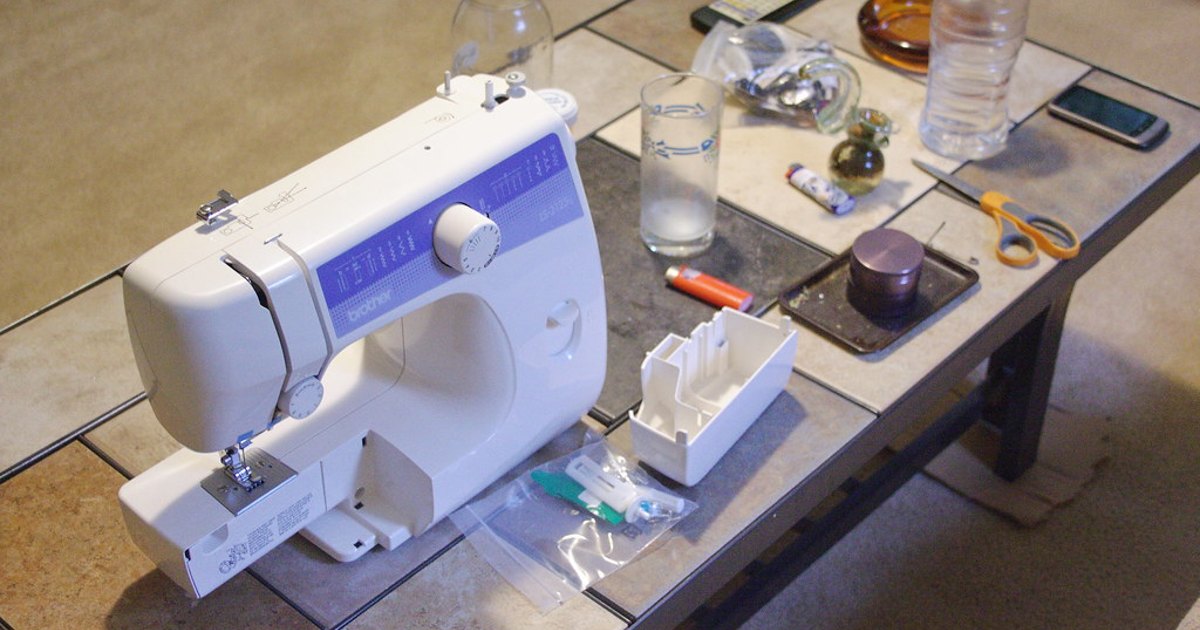
Photo: “sewing machine” by eggrole, via Flickr, licensed under CC BY 2.0. Resized and cropped. Illustrative stock photo; no product testing is implied.